Is God a Programmer? The Hidden Architecture of Creation, Eden, and the Fall of Adam
Reality has an architecture. This essay argues that God the Father authors its laws, gives humanity genuine freedom, and makes Eden the meeting point between Creator and creation.

1. God the Father as The Architect of Reality
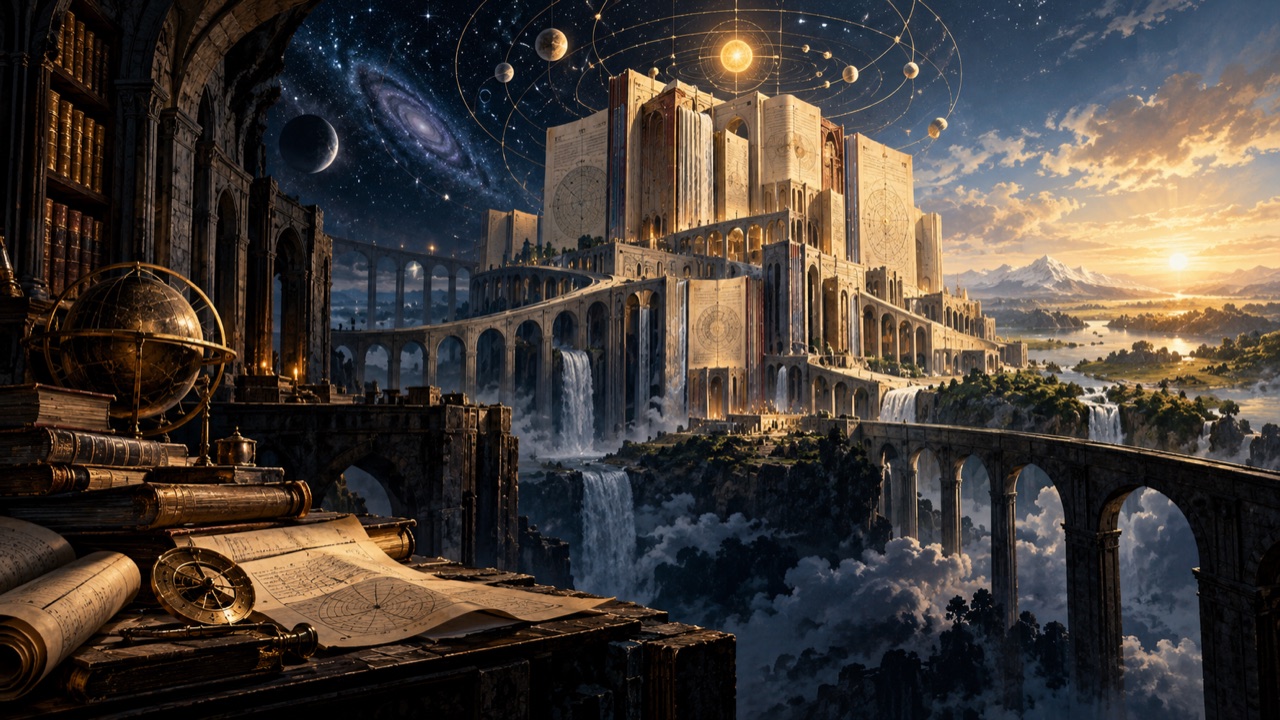
“In the beginning God created the heaven and the earth.” (Genesis 1:1)
When God created everything, he first defined the laws that govern everything including for example space, time, matter, spirit and causality,
This brings us to an interesting comparison with software engineering.
1.1. The Metamodel of Creation

In software engineering, a metamodel is a model that defines how other models can be constructed. It establishes the available concepts, their properties, relationships, and constraints.
For example, before developing a virtual world, a programmer must define what kinds of objects can exist, what properties they possess, how they interact, and which rules govern their behavior.
The individual objects are not the metamodel. They are instances of structures defined through it.
Now apply this idea to creation.
God the Father would not merely create the objects within the universe. He would first establish the underlying framework that makes their existence possible.
He defines what space and time are, how cause and effect operate, what distinguishes living beings from inanimate matter, and which interactions are possible.
Everything else builds upon this foundation.
The laws of physics, chemistry, and biology would be implementations of a deeper architecture established by the Creator. Even the most complex organisms would ultimately depend upon the same underlying order.
The essential difference between God and a human software engineer is that a human programmer works within existing laws, whereas God is the author of the created laws themselves.
1.2. From Divine Logic to a Living World

Once the underlying framework exists, more complex systems can be built upon it.
In software engineering, this involves several levels of abstraction:
- Metamodel: Defines the fundamental concepts and structural rules.
- Models: Describe particular systems using those concepts.
- Implementation: Turns those designs into functioning systems.
- Runtime: The environment in which the systems operate and interact.
Creation can be understood through a similar hierarchy. God establishes the foundations, defines the world, brings it into existence, and allows it to operate according to its laws.
Genesis repeatedly describes God creating through his word: “And God said, Let there be light: and there was light.” (Genesis 1:3)
The Gospel of John takes this further by describing the Logos, or divine Word, through whom all things were made (John 1:1–3).
In our analogy, divine commands do not merely describe reality. They bring it into being.
This does not mean God literally uses a programming language or that the universe is a computer simulation. The comparison helps us understand the distinction between creating things and establishing the rules that make those things possible.
1.3. A Multilayered Reality: From God to Eden

Modern computer systems operate across multiple layers. At the bottom is the hardware, upon which operating systems, applications, and virtual environments depend. Each layer operates within the capabilities granted by the layers beneath it.
God the Father: The Foundation of Existence
At the most fundamental level stands God the Father, the ultimate origin of everything.
The Greek word Archē (ἀρχή) means beginning, origin, or first principle. In our analogy, the Father is not merely the programmer who designed the system. He is also comparable to the underlying hardware upon which the entire created reality runs.
Every realm, every law, and every existing being ultimately depends upon him.
Of course, God is not literally a machine. Unlike physical hardware, he does not depend upon anything more fundamental to sustain his existence. The comparison expresses the idea that creation cannot exist independently of its source, while its source can exist independently of creation.
The Trinity: Root Access to Creation
In computer systems, the root user is an account with the highest level of administrative privileges.
Unlike ordinary users, who can access only certain files or perform permitted operations, root can modify the operating system itself. Depending on the system, root can install or remove software, alter configurations, create and delete user accounts, change permissions, inspect protected files, and override ordinary access restrictions.
Root access is therefore not merely the ability to use the system. It is the authority to administer its underlying operation.
Now imagine this concept applied to divine authority.
In our theological analogy, God the Father, his Son, and the Holy Spirit possess unrestricted authority over creation. They are not three separate computer accounts, but the three persons of the Trinity, sharing divine nature and authority.
Whereas created beings must operate within the laws of reality, divine authority is not restricted to the ordinary permissions assigned to creatures.
God could establish new laws, alter existing conditions, create something from nothing, or intervene within the world without requiring the permission of any created being.
What humans call a miracle could therefore be compared to an intervention at a level of reality inaccessible to ordinary inhabitants.
The important distinction is between having permission to act within creation and possessing authority over creation itself.
Heaven and the Angels: Privileged Users
Below the uncreated divine reality comes Heaven, the spiritual realm inhabited by angels.
Within this model, Heaven can be imagined as a higher-level environment with access to aspects of reality that remain hidden from the physical world.
Angels would not possess unrestricted divine authority. They would be created intelligences with different responsibilities, capabilities, and levels of access.
Christian angelology traditionally distinguishes several angelic orders, including angels, archangels, principalities, powers, dominions, virtues, thrones, cherubim, and seraphim.
The Seraphim occupy the highest rank in the influential hierarchy attributed to Pseudo-Dionysius. Within our software analogy, we can imagine them possessing extraordinary knowledge of creation and access to its most privileged operations, though their actual technical abilities are not described in scripture.
Lucifer was a seraph and among highest angelic beings before his rebellion. He was not an ignorant outsider attacking a system he knew nothing about. He is an exceptionally knowledgeable insider, familiar with the architecture of creation and the nature of its inhabitants.
Yet even the highest angel would remain a created being, incapable of possessing the unlimited authority of the Creator.
That distinction becomes crucial to understanding why deception, rather than force, would be such a powerful weapon.
Earth and Eden: Humanity’s Administrative Domain
Below the heavenly realms comes the physical world, governed by the laws of nature and inhabited by living creatures.
Within this world, Genesis introduces Eden.
We commonly imagine the Garden of Eden as a beautiful landscape filled with trees, rivers, and animals. God is described as walking in the garden, humanity has access to the Tree of Life. But the biblical narrative raises questions about whether Eden was simply an ordinary geographical location.
Perhaps Eden was something far more significant: the meeting point between Heaven and Earth, where two otherwise separate environments could interact directly.
In software engineering, complex systems are often maintained across distinct environments, such as development, testing, staging, and production. These environments are deliberately separated, each serving a different purpose and operating under its own configurations, permissions, and restrictions.
An application running in a development environment may have access to capabilities unavailable in production. Developers can inspect internal processes, modify configurations, and interact with components that ordinary users are never permitted to access. Integration environments allow separately developed systems to communicate and operate together before changes are introduced into production.
Now consider Heaven and Earth as two distinct environments within God’s creation. Heaven belongs to a higher spiritual order, while Earth operates according to the physical laws familiar to us. Eden could have functioned as an integration environment between them, where the boundaries separating these two realms were not yet closed to humanity.
This would explain several unusual features of the Genesis narrative. God could walk among Adam and Eve, spiritual beings could interact directly with humanity, and the Tree of Life was accessible within their environment. Eden would not simply have been a beautiful place on Earth, but a privileged domain in which heavenly and earthly realities intersected.
Adam and Eve were entrusted with this domain. Genesis 2:15 describes God placing Adam in the garden to cultivate and keep it, while Genesis 1:28 grants humanity dominion over the living creatures of the Earth.
In our software analogy, they were the authorized administrators of the earthly environment, possessing authority, freedom and responsibility.
We should also consider how such a reality would have been described thousands of years ago. The biblical account uses familiar images: a garden, trees, rivers, fruit, and God walking among his creatures. If God were communicating a reality far beyond the understanding of people in Moses’ time, these would have been natural ways to describe it. Ancient people had no technical language for dimensions, interfaces, operating environments, or different configurations of reality.
But what might Eden actually have looked like to Adam and Eve?
A World of Light, Not Merely Flesh
One of the most fascinating clues comes from Jewish mystical tradition.
Genesis 3:21 describes God clothing Adam and Eve in garments of skin, kotnot or (כתנות עור). Yet Genesis Rabbah 20:12 records an alternative reading associated with Rabbi Meir: kotnot or (כתנות אור), meaning garments of light.
The difference is a single Hebrew letter: Ayin (ע) for skin and Alef (א) for light.
Imagine, then, that the first humans were not confined to the same biological condition we experience today.
Their bodies might have been genuinely physical, capable of touching, eating, working, and embracing, while also possessing a spiritual dimension that was visible and active. Their radiance would not necessarily have resembled ordinary light emitted by a lamp. It could have been the outward manifestation of an inner life directly connected to God’s presence.
They would not have needed to perceive themselves as naked, vulnerable creatures separated from their environment. Their bodies and the world around them might have existed in complete harmony.
What Could Adam and Eve Actually See?
The Talmud contains an extraordinary tradition concerning the light created on the first day.
According to Chagigah 12a, this primordial light enabled a person to see from one end of the world to the other.
This suggests a form of perception far beyond ordinary human eyesight.
Suppose Adam and Eve could perceive aspects of reality that are completely invisible to us. They might have seen angels moving through Eden, recognized the spiritual nature of living creatures, or perceived the presence of God without requiring an extraordinary revelation.
Perhaps they did not experience Heaven as a distant destination. It was simply another dimension of the world around them, as accessible to their senses as the physical environment.
Their sight might have extended beyond ordinary distance, their understanding of nature might have been more immediate, and their awareness of creation might have included relationships that modern humanity can only attempt to reconstruct through observation and reasoning.
Even communication could have worked differently. Adam’s naming of the animals in Genesis 2:19–20 might be interpreted as more than assigning arbitrary labels. In a symbolic reading, it could represent an intuitive understanding of their nature and place within creation.
Imagine walking through a world in which the life of everything around you was immediately intelligible, where the visible environment revealed rather than concealed its deeper spiritual reality.
What Could They Do?
Their abilities would have followed from the environment in which they lived.
Genesis 1:26 tells us that God created humanity in his own image and granted them dominion over the Earth. But what did this dominion actually involve? Were Adam and Eve merely supposed to cultivate plants and look after animals, or did God entrust them with something far greater?
If Yahweh was the original programmer of reality, perhaps Adam and Eve were created to be programmers themselves, possessing a limited share of their Creator’s authority.
They would not have possessed God’s unrestricted root access, nor could they have rewritten the fundamental architecture of existence. Instead, they might have received administrative privileges over their own domain: Earth.
Imagine Adam standing before an unfinished landscape. Rather than spending years moving stones and digging rivers, he might have been able to alter his surroundings directly, commanding the environment to take a different form. He could introduce new arrangements of plants, reshape existing structures, remove unwanted obstacles, or execute commands that produced immediate changes in the physical world.
In software engineering terms, Adam and Eve might have possessed the ability to create, read, update, and delete elements of their environment, provided those operations remained within the permissions established by God.
Perhaps Adam and Eve were not placed into an entirely finished world. They were meant to develop it, expand it, and introduce things of their own. God had created the underlying architecture, but humanity was entrusted with shaping what would exist within it.
This would give an entirely different meaning to being made in God’s image. Humanity would resemble its Creator not only through intelligence, consciousness, and free will, but also through the delegated ability to transform reality through intention and command.
Unlike modern programmers, who must communicate with machines through keyboards and programming languages, Adam and Eve might have interacted with their environment directly. In a world where mind, spirit, and matter were more closely connected, a spoken command or an act of will could conceivably have been enough.
1.4. Adam and Eve: The Two Administrators of Creation

If Adam and Eve possessed the ability to modify their environment, why did God create two human beings instead of entrusting everything to one?
Genesis gives them distinct but complementary roles. Adam was created first and placed in Eden to cultivate and protect it (Genesis 2:15). He was also given the task of naming the animals, suggesting a responsibility for organizing and understanding the created world.
Eve was created as his ezer kenegdo, a Hebrew expression meaning a helper or counterpart corresponding to him (Genesis 2:18). She was not merely another inhabitant of Eden, but an independent human partner with whom Adam would share his responsibility. Genesis 1:28 grants dominion over creation to both man and woman.
Within our software engineering analogy, Adam could have been responsible for developing and maintaining the earthly environment, while Eve served as his complementary administrator, ensuring that decisions concerning their shared world were not made by Adam alone.
This arrangement resembles an important principle in computer security: dual authorization, also called the four-eyes principle.
In highly sensitive systems, a single administrator may not be permitted to execute critical operations independently. Changes affecting an entire environment can require approval from two authorized individuals. This prevents one compromised account, mistaken decision, or malicious insider from gaining complete control.
Multi-factor authentication (MFA) follows a related security principle by requiring independent forms of verification before access is granted. Strictly speaking, two separate administrators approving a change is dual authorization rather than MFA, but both approaches introduce additional safeguards.
Now imagine that God designed humanity’s authority over Earth according to a similar principle.
Adam and Eve might each have possessed administrative privileges, but the most consequential changes to their world could have required their mutual participation. Adam could propose or initiate an operation, while Eve could independently approve, reject, or influence it. Neither would possess absolute authority over their shared domain.
Two independent human wills would therefore act as a safeguard against the misuse of humanity’s delegated power.
There is another reason why such a design would make sense. God had granted humanity genuine freedom, and freedom introduces the possibility of error. Rather than removing that freedom, he could have protected the earthly environment by distributing authority between two individuals.
This would make Adam and Eve more than husband and wife. They would be the founding administrators of human civilization, jointly entrusted with developing creation while respecting the boundaries established by its original architect.
Different Responsibilities: Development and Exploration
Their responsibilities may have extended beyond simply approving each other’s decisions.
Adam’s primary role may have been construction, organization, and maintenance. He would have acted as the principal developer of the earthly environment, responsible for implementing changes, introducing new structures, organizing living creatures, and ensuring that creation continued to function according to God’s design.
Eve’s role, meanwhile, may have been exploration, discovery, and innovation. Rather than concentrating on maintaining what already existed, she could have investigated the possibilities of creation, discovered new capabilities, experimented with ideas, and proposed ways to expand their world.
In modern software engineering, these responsibilities resemble the distinction between research and development. Research explores what is possible, while development turns those discoveries into working solutions.
Together, Adam and Eve could have continuously expanded the earthly world. Eve might discover new possibilities and bring them to Adam, while Adam could determine how to implement them without compromising the stability of their environment.
1.5. Free Will in Eden: A World of Open Possibilities
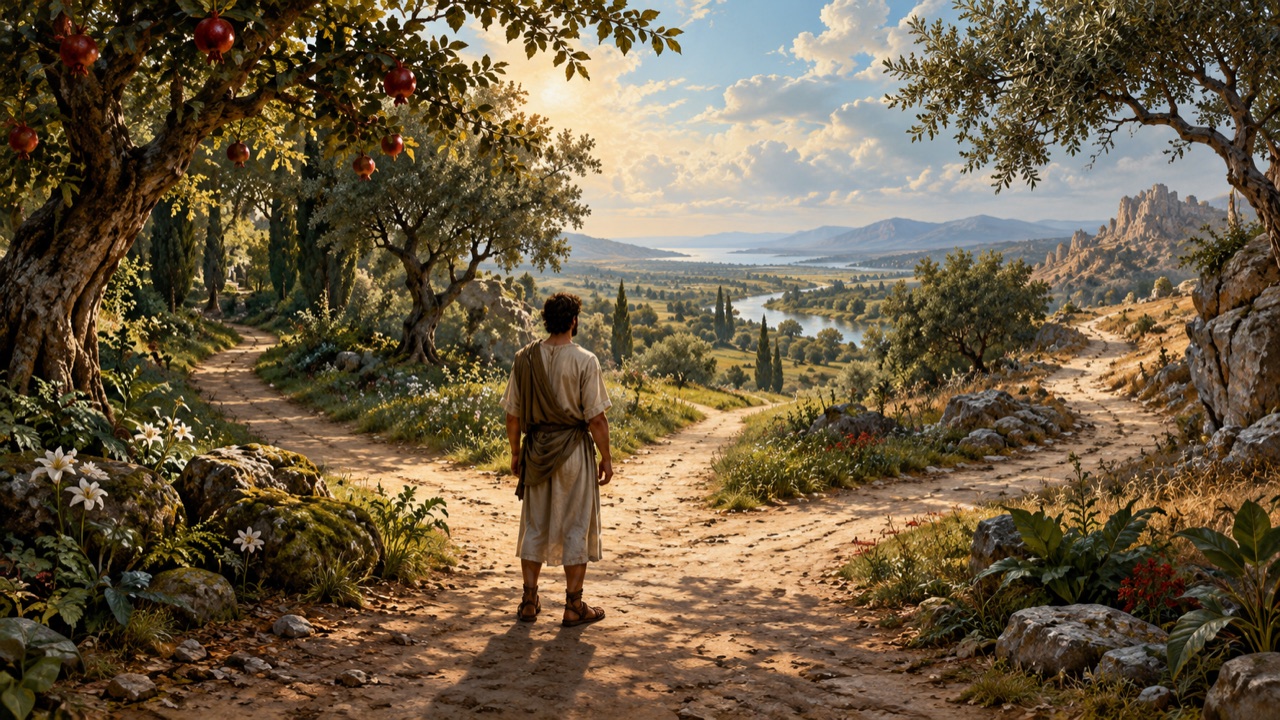
Before examining Adam and Eve’s authority over creation, we need to understand how free will might have operated in Eden. After all, if God designed reality like a software engineer, did he also predetermine every decision his creatures would ever make?
Perhaps not. What if the original creation operated according to a logic in which the future was genuinely open, even to God himself?
In classical computing, a bit has one of two definite values: 0 or 1. Quantum computing, however, introduces a different concept. A qubit can exist in a superposition of states, allowing quantum operations to work with possibilities in ways ordinary binary computation cannot.
Although quantum mechanics does not establish how free will works, it provides an interesting analogy for the world of Eden.
Imagine that the future was not a sequence of predetermined events, but a collection of possibilities that remained open until a conscious being made a decision.
Adam and Eve might have lived in a reality where their choices genuinely determined what would happen next. They could explore different possibilities, develop creation in different directions, and introduce outcomes that had never existed before.
Their freedom would not merely consist of choosing between options whose results had already been written into history. They would participate in determining which possible future became real.
In software engineering terms, the universe would have been a running system rather than a prerecorded simulation. Its architecture and rules were established, but its history was still being written by those living within it.
But Would God Himself Know the Outcome?
This raises a more difficult question. If Yahweh created every possible future, wouldn’t he already know which one Adam and Eve would choose?
One possible answer is that knowing everything that can happen is not necessarily the same as knowing which possibility will become reality before it is chosen.
God could understand every possible decision, every consequence, and every future arising from those decisions. Nothing would be beyond his comprehension.
Yet if the future had not actually been determined, there would be no completed outcome to observe.
This resembles a theological position known as open theism, which argues that God knows reality perfectly, including its genuine possibilities, without every future free decision already being settled.
Under this model, God would not be ignorant of his creation. He would know its entire architecture and every possible way it could develop. What remained open was the actual decision of a free creature.
God’s Own Freedom
Perhaps this openness applied to God as well.
Although Yahweh designed the system, he might have chosen to experience its unfolding history alongside his creatures rather than dictate every event in advance.
He could intervene, introduce new possibilities, respond to human decisions, or simply allow creation to develop according to the freedom he had granted it.
This would make God’s relationship with Adam and Eve genuinely interactive. Their decisions would matter not merely because they experienced them as free, but because those decisions helped determine the future that even God had chosen not to predetermine.
And that brings us to an important distinction.
God may have written every rule governing creation without writing every decision that would ever be made within it.
In such a world, Adam and Eve would not simply execute a divine script. They would be genuine participants in creation, entrusted with the freedom to develop it in directions that were possible, but not yet actual.
Their choices would become part of reality itself.
1.6. The First Cyberattack: How Satan Exploited Human Free Will

If Adam and Eve were entrusted with administrative authority over Earth, then Satan faced a serious problem. He may have possessed extraordinary knowledge of creation and its underlying architecture, but he lacked the permissions necessary to take control of the earthly environment himself.
He could not simply override God’s authority. Instead, he needed Adam and Eve to exercise their own privileges on his behalf.
In cybersecurity, this is known as social engineering: manipulating an authorized user into performing an action that an attacker cannot perform directly.
And this is precisely how the serpent approaches Eve in Genesis 3.
The Tree of Knowledge: A Malicious Executable?
The Tree of the Knowledge of Good and Evil is usually understood as an ordinary tree whose fruit God had forbidden humanity to eat. But within our software-engineering analogy, we can imagine something considerably more dangerous.
What if the tree functioned like an executable file containing malicious code, capable of altering the environment when activated by an authorized user?
In the more radical version of this theory, Satan could have used his remaining knowledge and creative abilities to construct a malicious object within Eden.
The tree would be the delivery mechanism, its fruit the executable, and eating the fruit the action that initiated the operation.
Such an attack resembles a Trojan horse, malicious software disguised as something useful or desirable. Unlike an obvious threat, a Trojan encourages its intended victim to run it voluntarily.
The consequences might also resemble self-replicating malware. If Adam and Eve’s actions could alter the conditions of their entire domain, the resulting corruption could propagate beyond the original two users, affecting their descendants and the world they inhabited.
Lucifer’s Social Engineering Attack on Eve
Satan’s greatest weapon was not brute force, but deception.
The Apostle Paul later describes Satan as capable of disguising himself as an angel of light (2 Corinthians 11:14). Although Genesis presents the tempter as a serpent rather than explicitly describing a shining angel, the wider Christian tradition associates Satan with the ability to appear trustworthy and benevolent.
This is an important feature of social engineering. Successful attackers rarely introduce themselves as enemies. They impersonate trusted authorities, conceal their intentions, and present dangerous actions as beneficial opportunities.
Satan’s approach to Eve follows a similar pattern.
He begins by questioning God’s instructions:
“Yea, hath God said, Ye shall not eat of every tree of the garden?” (Genesis 3:1)
Notice that he does not immediately command Eve to disobey. He first encourages her to reconsider what God has told her.
When Eve explains that eating from the forbidden tree would bring death, the serpent directly contradicts the warning:
“Ye shall not surely die.” (Genesis 3:4)
He then introduces the real temptation: eating the fruit will open their eyes and make them like God, knowing good and evil.
The attack is remarkable because Satan presents disobedience not as rebellion, but as an opportunity for improvement.
Within our earlier interpretation, Eve’s responsibilities may have involved exploration, discovery, and innovation. Satan would therefore have been appealing directly to the qualities that made her valuable as an administrator.
He offered her something new to discover, a capability supposedly withheld from humanity, and the promise of becoming more like her Creator.
Genesis 3:6 describes Eve seeing that the tree was good for food, pleasing to the eyes, and desirable for gaining wisdom.
In other words, the proposed operation appeared attractive, beneficial, and intellectually rewarding.
The malicious payload was concealed behind the promise of an upgrade.
Adam’s Choice: Love or Loyalty to God?
This brings us to the most tragic part of the story.
Unlike Eve, Adam may have understood exactly what had happened.
The distinction has a biblical foundation. In 1 Timothy 2:14, Paul states that Adam was not deceived, whereas Eve was deceived.
Within our interpretation, Adam recognized that Eve had executed something forbidden. He may even have witnessed the consequences: the loss of her former privileges, the alteration of her nature, and the separation beginning to emerge between them.
He now faced a terrible choice.
He could refuse the fruit, remain obedient to God, and risk losing the woman who had been created as his counterpart. Or he could join Eve, accepting the consequences of an operation he knew should never have been executed.
Perhaps Adam did not eat because he believed Satan’s promise. Perhaps he ate because he could not bear to let Eve face the consequences alone.
This would explain why Satan needed to deceive only one of them.
Eve’s curiosity had been exploited to initiate the operation. Adam’s attachment to Eve could then become the means of securing the second authorization.
And unlike Eve, Adam would have acted with an understanding of the danger.
The tragedy is that his decision to remain with Eve would not restore her lost privileges. Instead, it could complete the operation that compromised them both.
Adam: The Second Authorization
What matters in our model is that Adam did not prevent the forbidden action. Instead, he participated in it.
This completes the proposed dual-authorization sequence.
Eve, the explorer, had accepted the promise of a new capability. Adam, the developer and maintainer, then joined her decision.
The attacker had succeeded in persuading both authorized administrators to cross the boundary established by their Creator.
Satan never needed root access. He exploited the legitimate permissions of those who already possessed authority over Earth.
If the forbidden action functioned like executing malicious code, its consequences could now extend beyond Adam and Eve themselves.
Why Did God Allow the Attack?
This leaves us with perhaps the most difficult question of all.
If God the Father designed the entire system, why did he not intervene before Satan succeeded?
The answer may lie in the nature of free will.
As discussed earlier, perhaps the original creation operated with an open future in which human decisions were not predetermined. God knew the possible consequences of disobedience, but allowed his creatures to decide which possibility would become reality.
Preventing every dangerous decision would have meant restricting the very freedom he had granted them.
In cybersecurity terms, God had established the architecture, defined its boundaries, and warned its administrators about a forbidden operation. Yet he did not automatically override their decisions whenever they approached that boundary.
Perhaps he deliberately allowed the choice to remain genuine, even when another intelligence attempted to manipulate it.
This would not make Satan’s deception God’s own action. It would mean that the Creator permitted his world to contain real freedom, including the possibility that freedom could be misused.
And once both Adam and Eve had acted, the consequences could no longer be understood as an isolated mistake.
In our model, the administrators of Earth had executed an operation that fundamentally altered their relationship with the environment they governed.
The Fall was not Satan overpowering God. It was Satan persuading humanity to use its God-given authority against the instructions of its Creator.
The question is what happened when that operation executed—and why the world that followed was so different from Eden.
1.7. The Malicious Update: How Satan Trapped Himself in the Fallen World
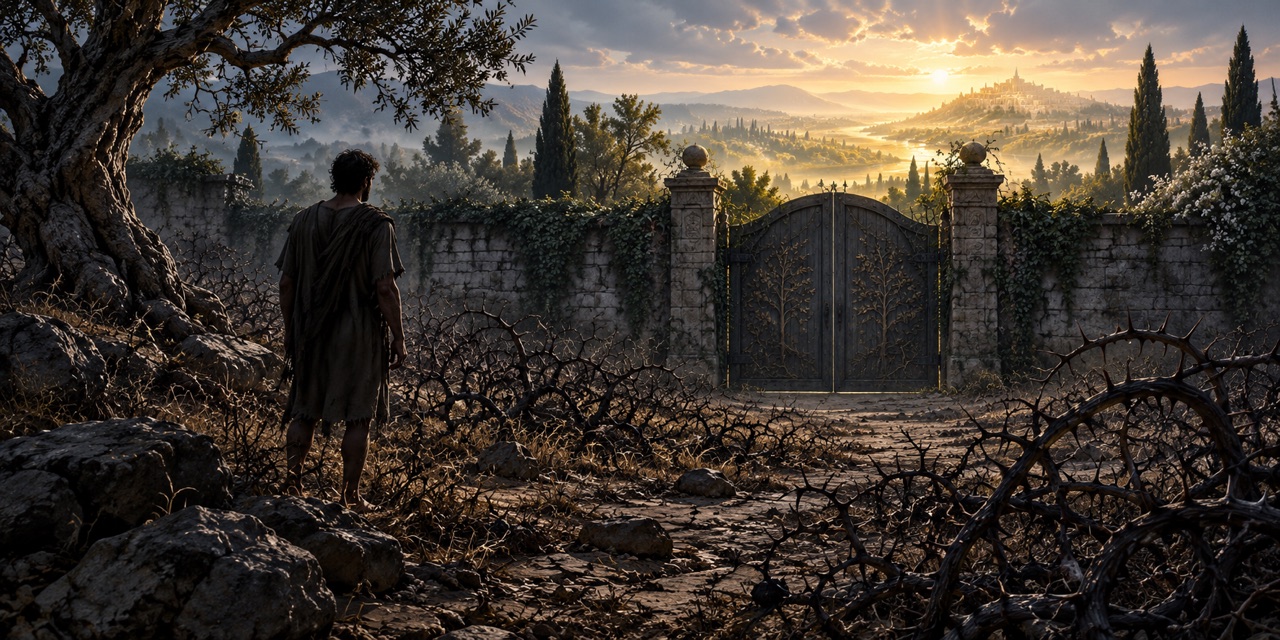
What exactly did Satan hope to accomplish by corrupting Adam and Eve?
If humanity possessed administrative authority over Earth, Satan’s ultimate objective may have been to acquire those privileges for himself. By manipulating the two administrators into executing his malicious code, he could have expected to inherit their permissions, gain control over the earthly environment, and eventually establish his own kingdom within God’s creation.
But something may have gone terribly wrong with his plan.
Satan succeeded in corrupting humanity, but failed to obtain the authority he expected. Instead, God disconnected the compromised environment from the higher realms, trapping the attacker within the very world he had corrupted.
What Did the Malicious Script Actually Change?
In cybersecurity, malware does not necessarily destroy an entire system. It may modify critical configurations, weaken security controls, establish persistent access, or change how applications behave.
Imagine the forbidden fruit as an executable carrying instructions intended to alter the configuration of human existence.
The malicious operation could have targeted three fundamental aspects of creation: humanity’s privileges, its relationship with God, and the conditions under which the earthly environment operated.
Adam and Eve’s original bodies, perhaps once capable of interacting with both physical and spiritual reality, would become restricted to a lower mode of existence. Their direct access to divine life would be interrupted, and abilities they previously exercised through their connection to Heaven would no longer function.
Most importantly, the corruption could become persistent. Rather than affecting Adam and Eve alone, the altered condition would be inherited by every subsequent generation.
In programming terms, the compromised state would become part of humanity’s default configuration. Every new human being would be born into the same restricted environment.
This provides a technological analogy for the Christian doctrine of the Fall affecting the entire human condition.
But there was a limit to what Satan’s malicious code could accomplish. He could compromise the administrators, but he could not force the Creator to surrender ownership of the system.
God’s Response: Quarantining the Compromised Environment
This is where the story takes an unexpected turn.
If Satan had successfully exploited humanity’s permissions, the greatest danger might have been allowing the compromised environment to remain connected to Heaven.
In cybersecurity, when an attacker compromises part of a network, administrators often respond through network segmentation and quarantine. The infected environment is isolated from critical infrastructure to prevent the attack from spreading.
Perhaps God did something similar.
Rather than allowing Satan to exploit the connection between Heaven and Earth, the Father could have severed the privileged interfaces through which the two realms interacted.
The physical world would continue operating, but no longer under the same conditions as Eden.
Humanity would lose its former administrative privileges. Direct access to the Tree of Life would be withdrawn, and the earthly environment would operate under stricter limitations.
Genesis 3:24 describes God placing cherubim and a flaming sword to guard the way to the Tree of Life.
Within our analogy, this resembles a protected gateway whose access permissions have been permanently revoked.
Eden was not simply abandoned. Access to the higher environment was deliberately blocked.
And this decision could have defeated Satan’s original objective.
Satan’s Mistake: He Lost Access Too
Suppose Satan expected that corrupting Adam and Eve would transfer their administrative authority to him.
He may have believed that once humanity was compromised, he could use its permissions to modify creation however he pleased.
But what if those permissions depended upon the connection between Heaven and Earth?
The moment God disconnected the environments, the privileges Satan hoped to acquire became unusable.
Adam and Eve could no longer execute the extraordinary commands they once possessed. Yet neither could Satan exploit those same capabilities to gain control over creation.
He might still be able to deceive, tempt, influence, and manipulate human beings, but he would no longer have unrestricted access to the deeper architecture of reality.
In technical terms, Satan had compromised the users but lost access to the privileged services their accounts once provided.
He had expected to become the administrator of an extraordinary world. Instead, he found himself operating within a restricted environment governed by laws he could not override.
This would explain why the devil’s power, in our model, increasingly depends upon influencing human decisions rather than simply commanding reality to obey him.
The Gospels contain an interesting parallel. In Luke 4:6, Satan claims authority over the kingdoms of the world when tempting Jesus. Yet this is a claim made by the tempter himself, not proof that he possesses God’s unrestricted authority.
Satan could become a ruler within the fallen system without ever becoming its true owner.
His victory over humanity would therefore conceal a defeat of his own.
God’s Curses: The New Rules of Reality
But there remains a difficult question.
If God was the ultimate architect, wasn’t he the one who actually enforced the new conditions?
Genesis 3 describes God announcing the consequences of the Fall. The serpent is condemned to crawl upon its belly, Eve faces suffering in childbirth and conflict within human relationships, while Adam must struggle against a resistant earth until he eventually returns to dust.
These pronouncements can be interpreted, within our model, as the terms of the new earthly environment.
The curse upon the serpent would symbolize the restriction and humiliation of the attacker. The hostility God establishes between the serpent and the woman’s descendants would ensure that humanity and its deceiver would not remain natural allies.
Eve’s suffering would reveal that even the creation of new human life had become difficult. What may once have been a harmonious process now operated through physical vulnerability, pain, and dependence.
Adam’s punishment is especially significant. The earth would no longer respond to him as it once had. Instead of exercising effortless creative authority, he would have to cultivate an environment that resisted his intentions.
The ground would produce thorns and thistles. Food would require labor, and every human body would eventually return to dust.
In our analogy, humanity had been reduced from privileged administrators to ordinary users of a world they could no longer freely modify.
The change was not merely a punishment imposed upon two individuals. It marked a new relationship between humanity and the environment itself.
Romans 8:20–22 offers an interesting theological parallel by describing creation as subjected to futility and bondage to decay, while still retaining the hope of eventual liberation.
Why Would God Authorize Such a Terrible Update?
This is perhaps the most important distinction in the entire theory.
Satan initiated the malicious operation, but God determined the conditions under which the compromised world would continue to exist.
Why not simply reverse everything?
Because restoring the previous state might not have been as simple as deleting a malicious file.
In software engineering, a rollback restores a system to an earlier state. But if an operation has already produced irreversible external consequences, restoring the old configuration does not necessarily undo everything that happened.
Applied to creation, God could have restored Eden immediately through his omnipotence. But doing so might have meant erasing or overriding the consequences of genuine human choices.
Perhaps the Father chose a different solution: allow the history resulting from those choices to continue, while preventing the corruption from spreading into the higher realms.
There is also the question of immortality.
In Genesis 3:22, God explicitly prevents humanity from obtaining eternal life through the Tree of Life after acquiring the knowledge of good and evil.
From a security perspective, this could be understood as preventing a compromised state from becoming permanent.
Mortality, as terrible as it is, would prevent the corrupted human condition from continuing indefinitely in the same individual.
The new environment would be painful and restrictive, but it would not necessarily be the final version of creation.
Indeed, the same passage in Romans that describes creation’s bondage also speaks of its future liberation.
Perhaps God’s response was therefore not simply a punishment, but a combination of containment, restriction, and the preservation of a future possibility of restoration.
The Prison Satan Built for Himself
The irony of the Fall becomes apparent when we look at the outcome from Satan’s perspective.
He may have expected to gain the rights of humanity, seize control of the earthly environment, and use it as a foundation for expanding his rebellion.
Instead, he would have achieved almost the opposite.
Humanity lost its extraordinary abilities. Earth became separated from the privileged heavenly environment. The connection through which Satan hoped to exercise greater power was closed, and he found himself restricted to influencing a world whose fundamental laws remained beyond his authority.
He could corrupt human decisions, but he could not become Yahweh.
He could establish influence over earthly kingdoms, but he could not reclaim the original access to Eden.
And he could make humanity suffer, but he could not guarantee that its condition would remain unchanged forever.
Within this speculative interpretation, God had allowed Satan’s attack to succeed at the human level while ensuring that it failed at the architectural level.
Satan gained influence over a fallen world, but lost the greater prize he had hoped to possess.
He had tried to steal the keys to creation, only to discover that the Creator had changed the locks.
And the resulting question was no longer whether Satan could conquer Heaven through humanity, but whether God would eventually restore the connection between the two realms—and what would become of the fallen world when he did.
1.8. Jesus Christ: The Second Adam and the Restoration of Humanity
Satan’s victory in Eden had an unexpected consequence. He had failed to acquire humanity’s original administrative privileges, but he had gained something else: a permanent accusation against the human race.
Adam and Eve had knowingly or unknowingly violated God’s command, and their descendants inherited a world governed by death, suffering, and separation from the divine presence.
Yet this created a problem that even righteous human beings could not overcome. Abraham, Moses, David, and the prophets could live faithfully before God, but none could escape death or restore humanity’s original access to Heaven.
The problem was no longer simply that humans committed sins. Humanity itself existed within a fallen condition that no ordinary human could reverse.
Satan the Accuser: The Legal Consequences of the Fall
The Hebrew word Satan (שטן) means adversary or accuser. In Job 1–2 and Zechariah 3:1, Satan appears in a heavenly setting, challenging or accusing human beings before God. Revelation 12:10 likewise identifies him as the accuser of God’s people.
This gives us another way to understand what Satan obtained through the Fall.
He did not become the rightful owner of creation, nor did he acquire God’s root privileges. Instead, he gained leverage over humanity through its disobedience and mortality.
In cybersecurity, an attacker who cannot seize control of a system may still obtain sensitive information, compromise its users, or exploit their violations of established policies. The attacker can then use those violations to threaten, manipulate, or blackmail them.
Satan’s position could be compared to that of a malicious prosecutor who continually points to humanity’s record of wrongdoing.
Every new sin strengthens the accusation. Even those who attempt to live righteously remain descendants of Adam and subject to death.
The devil could therefore exercise influence over a humanity that feared death and struggled to escape its fallen condition. Hebrews 2:14–15 explicitly connects the devil with the power of death and humanity’s bondage through fear.
However, Satan was never the ultimate judge. His accusations did not place him above God’s authority.
He could point to humanity’s guilt, but he could not determine whether God would ultimately forgive, redeem, or restore humanity.
Why the Righteous Dead Could Not Enter Heaven
Here we encounter one of the oldest Christian mysteries: why did Jesus need to descend into the realm of the dead?
Before Christ’s resurrection, even the righteous figures of the Old Testament were understood in important Christian traditions as awaiting redemption.
The Hebrew Bible calls the realm of the dead Sheol, while the Greek New Testament uses Hades. These terms should not automatically be confused with the final place of punishment commonly imagined when people speak of Hell.
In Luke 16:22, Jesus describes Lazarus being received into Abraham’s bosom, a place of comfort distinct from the suffering experienced by the rich man.
Catholic and Eastern Christian traditions developed the understanding that the righteous dead awaited the Savior who would open the way to Heaven.
Within our software analogy, these people were not necessarily imprisoned because of their personal wickedness. They were inhabitants of an environment whose original connection to the higher realm had not yet been restored.
Abraham could be righteous, Moses could speak with God, and David could repent sincerely. Yet none possessed the authority to reverse Adam’s original condition.
Their righteousness did not automatically grant them access to a realm from which humanity had been separated.
This raises the central problem of salvation.
Who could enter the fallen world as a genuine descendant of Adam, overcome the condition Adam introduced, and reopen the way to Heaven?
An ordinary human lacked the necessary authority. An angel could not legitimately represent humanity in its entirety. And merely issuing a divine command would not, by itself, accomplish the restoration of human nature from within.
Christianity presents the Incarnation as the answer.
Why God Sent His Son as a Human Being
John 1:14 declares that the divine Word became flesh.
This was not simply God appearing in human form. According to classical Christian theology, the eternal Son genuinely assumed human nature while remaining divine.
The distinction is essential.
If Jesus had only appeared human, his obedience, suffering, and death would not have represented the human condition he came to redeem.
If he had been merely human, he could have lived righteously, but he would not have possessed divine authority over death and the restoration of creation.
Jesus needed to be fully human to represent humanity and fully divine to accomplish what humanity could not accomplish for itself.
The Council of Chalcedon in 451 expressed this through the doctrine of two natures united in one person: Jesus Christ is fully God and fully man, without either nature being absorbed into the other.
Our software analogy offers a way to understand this.
Imagine the original architect entering his own creation, not as an external administrator operating through a privileged console, but as a genuine participant within the environment.
He accepts its ordinary limitations, experiences its suffering, and lives according to the conditions under which its inhabitants exist.
Yet his divine identity remains what it always was.
Jesus would therefore possess something no ordinary inhabitant had: genuine membership in the human world united with divine authority.
He could act from within the fallen environment without ceasing to belong to the divine reality beyond it.
Why the Virgin Birth Matters
But why was Jesus born of a virgin? Why did he have a human mother but no biological human father?
Genesis 3:15 contains an early promise that the offspring of the woman will stand against the serpent. Christian tradition later interpreted this passage as anticipating Christ’s victory over Satan.
The Gospel of Luke describes Jesus being conceived through the Holy Spirit rather than through ordinary human generation.
Within our model, the virgin birth represents a new divine initiative within humanity’s existing history.
Jesus is genuinely born of Mary. His human nature is not artificial, and he does not simply appear on Earth as an adult. He enters the world through human birth, sharing the nature of those he intends to save.
Yet his conception does not originate from an ordinary human father. His personal identity is that of the eternal Son.
In software terms, this could be compared to the original architect introducing a new instance into a compromised environment through a process that does not depend entirely upon the environment’s ordinary mechanisms.
Its significance is theological. Jesus represents both continuity with Adam’s humanity and a new beginning initiated by God.
He is not another independent human administrator attempting to repair the damage.
He is the divine Son entering humanity’s condition without personally participating in Adam’s rebellion.
The Sinless Life: Where the First Adam Failed
Jesus’ sinlessness becomes even more important when viewed against the original attack in Eden.
The first Adam encountered a forbidden possibility and disobeyed. Jesus, whom Paul calls the Last Adam in 1 Corinthians 15:45, faced temptation and remained obedient.
In the wilderness, Satan tempted Jesus with food, miraculous demonstrations of power, and authority over the kingdoms of the world (Matthew 4:1–11).
The parallels with Eden are striking.
Satan again attempted to persuade a human being to misuse his freedom and privileges. This time, however, he was confronting someone who understood the temptation and refused to cooperate.
Jesus did not use his divine status to escape the human experience of obedience. He endured temptation while remaining faithful to the Father.
His miracles also reveal a different relationship with creation. He heals diseases, commands storms, multiplies food, and raises the dead.
Within our analogy, these acts resemble operations that ordinary users of the fallen environment could no longer perform.
Yet Jesus does not use this authority to establish an earthly dictatorship or seize humanity’s freedom.
His purpose is to restore rather than exploit.
Where Satan offered humanity power through disobedience, Jesus demonstrates power exercised in obedience.
Why Jesus Had to Be Crucified
This brings us to the most difficult part of the entire operation.
If Jesus was sinless and possessed divine authority, why allow himself to be arrested, humiliated, tortured, and executed?
Why not simply defeat Satan through an overwhelming display of power?
Because the problem was not merely the presence of an enemy. It was the condition of humanity itself.
The consequences of Adam’s Fall included death. Every generation inherited a world in which human life eventually ended, regardless of individual righteousness.
Jesus came not merely to avoid that consequence, but to enter it and overcome it.
Hebrews 2:14 explains that the Son shared in human flesh and blood so that through death he might defeat the devil’s power over death.
Consider what this means within our model.
Satan’s entire strategy depended upon humanity remaining trapped within mortality, guilt, and separation from God.
But Jesus was different. He was genuinely human, yet without sin. He voluntarily entered death without having personally earned condemnation through disobedience.
The devil’s greatest weapon was now being directed against someone whose divine life could not ultimately be conquered by it.
The crucifixion also has a legal dimension.
Colossians 2:14–15 describes Christ’s work as canceling the record of debt against humanity and triumphing over hostile spiritual powers.
In the language of our analogy, the accusations that Satan had used against humanity were deprived of their condemning force through Christ’s sacrifice.
The Cross was not a payment made to Satan in exchange for ownership of human souls. Rather, it was the means by which Christ confronted human guilt, fulfilled his obedience to the Father, and broke the dominion of sin and death.
There is another remarkable contrast.
Adam had chosen to follow Eve into the consequences of disobedience. Jesus willingly entered the consequences of humanity’s disobedience without committing the same offense.
The first Adam participated in the Fall. The Last Adam entered the fallen condition to overcome it.
Even the location of Jesus’ final submission is significant. In the Garden of Gethsemane, Jesus accepts the Father’s will despite the suffering awaiting him (Luke 22:42).
Where disobedience began in a garden, obedience is reaffirmed in another.
The Descent into Hell: Recovering the Lost Humanity
According to the Apostles’ Creed, Jesus descended to the dead before rising again.
In the traditional Christian interpretation known as the Harrowing of Hell, Christ entered the realm of the dead to announce his victory and liberate the righteous who had awaited redemption.
First Peter 3:18–19 speaks of Christ proclaiming to imprisoned spirits, although Christians interpret the passage in different ways.
The meaning of the descent becomes especially powerful within our model.
Until this point, the righteous dead had remained within a domain from which they could not restore their own access to Heaven.
Now the divine Son had entered that domain as a genuine human being.
He was not another captive subject to the same final limitations. He had entered death voluntarily, and death could not permanently hold him.
The prison was confronted by someone who possessed authority over its ultimate fate.
The ancient Christian image is not merely that Jesus escapes from the realm of the dead, but that he comes to retrieve those who could not escape by themselves.
Adam himself becomes central to this imagery.
In an ancient Holy Saturday homily preserved in Catholic tradition, Christ is portrayed searching for Adam and Eve among the dead, calling the first human being to rise.
The symbolism is extraordinary: the Last Adam descends to recover the First Adam.
The original administrator of humanity, whose decision had helped introduce the fallen condition, is sought by the one who has come to restore what was lost.
The Resurrection: A New Human Condition
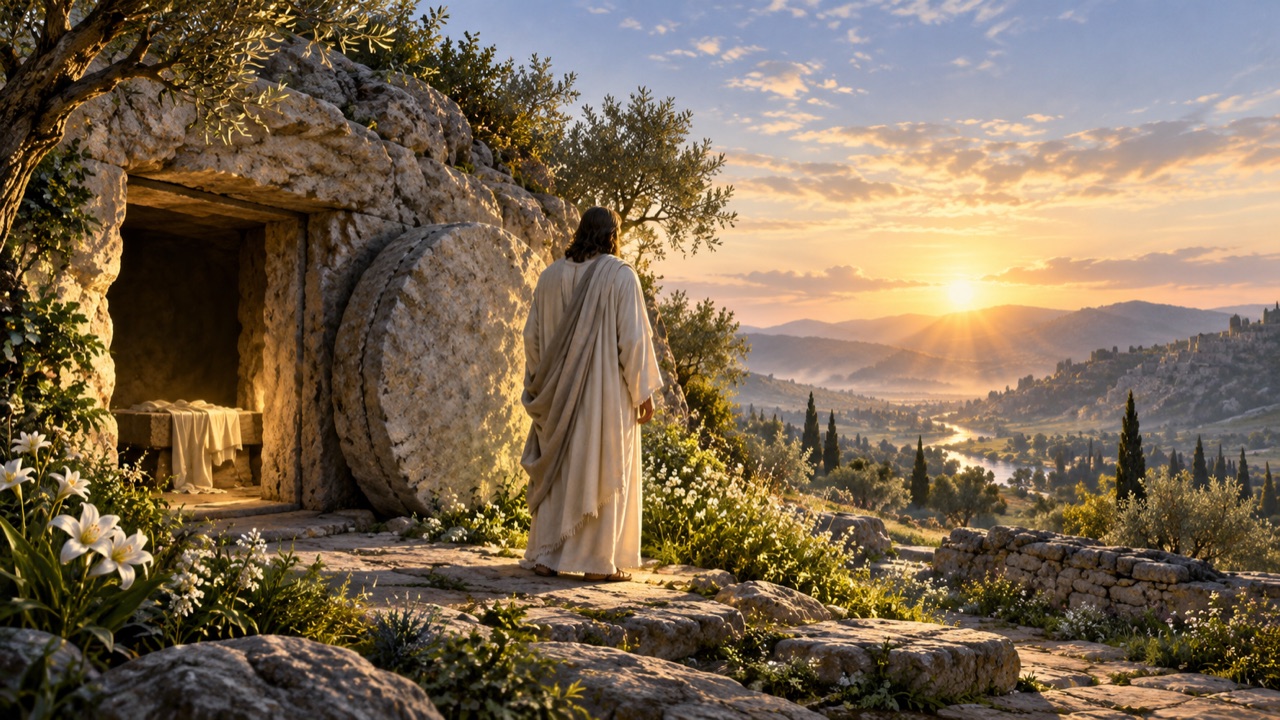
The resurrection completes what the crucifixion and descent began.
Jesus does not merely return to ordinary mortal life, as Lazarus had done when Jesus raised him.
He rises in a transformed, glorified human body.
The Gospels portray the risen Jesus as physically recognizable and capable of eating and being touched, yet no longer subject to death in the ordinary way. His appearances also suggest a freedom from familiar physical limitations.
In our software analogy, this would be more than restoring an earlier version of the human system.
The resurrection introduces a new condition of humanity in which death no longer possesses the final authority.
Paul develops this distinction in 1 Corinthians 15, contrasting the earthly Adam with the heavenly Adam and the mortal body with the resurrected body.
The original creation had produced living human beings who could fall and die. The resurrection reveals the possibility of humanity participating in an imperishable form of life.
Jesus therefore does not simply reopen the old Garden of Eden.
He establishes the foundation for something greater: the restoration and eventual transformation of humanity itself.
Revelation 1:18 presents the risen Christ as possessing the keys of Death and Hades.
Within our analogy, this is the decisive reversal of Satan’s advantage.
The devil had used death to enslave humanity through fear. The risen Christ now possesses authority over death itself.
The accuser’s case has been answered, the righteous dead are no longer without hope, and the separation introduced by the Fall is no longer humanity’s unavoidable final destiny.
Nevertheless, suffering, sin, and physical death continue to exist in the present world. Christian theology therefore distinguishes Christ’s accomplished victory from the final restoration of creation, which remains future.
The decisive intervention has occurred, but the whole world has not yet been transformed.
Jesus came not merely to repair the damage caused by Adam, but to make possible a new humanity that could no longer be permanently imprisoned by the consequences of the Fall.
And this leaves one final question for our software-engineering interpretation: if Jesus defeated death and restored humanity’s access to God, why does the earthly environment still operate under so many of the restrictions introduced after Eden?