When God Meets Adam Again: The End of the World or the New Beginning of Humanity?
The relationship broken in Eden returns to the center of history. This essay makes the case for a second divine incarnation—the Father’s lasting union with Adam that heals the human will and opens a new beginning for creation.
1.1. What Jesus Christ Accomplished: The Work of the Last Adam
To understand why God the Father might have a final role in humanity’s restoration, we must first understand what his Son, Jesus Christ, has already accomplished.
According to Christianity, Jesus is the eternal Son of God who became fully human while remaining fully divine. Born of the Virgin Mary through the Holy Spirit, he assumed not merely a human body, but an entire human nature, including a human mind, soul, and will. Yet unlike Adam, he was born without sin and remained obedient to the Father throughout his life.
The Apostle Paul calls Jesus the Last Adam (1 Corinthians 15:45), establishing a direct comparison between the two. Where the First Adam disobeyed God and brought death into the human condition, the Last Adam obeyed and opened the way to eternal life.
Jesus accomplished this through several decisive acts.
He resisted Satan’s temptations, healed the sick, forgave sins, cast out demons, and demonstrated authority over nature itself. His miracles revealed powers that ordinary humanity no longer possessed.
Through his crucifixion, he voluntarily entered death despite having committed no sin. His sacrifice addressed humanity’s guilt, fulfilled his obedience to the Father, and deprived Satan, the accuser, of his claim against those redeemed through Christ.
According to the ancient Christian tradition of the Harrowing of Hell, Jesus then descended into the realm of the dead, where the righteous of earlier generations awaited their liberation. There, he proclaimed his victory and opened the way to Heaven.
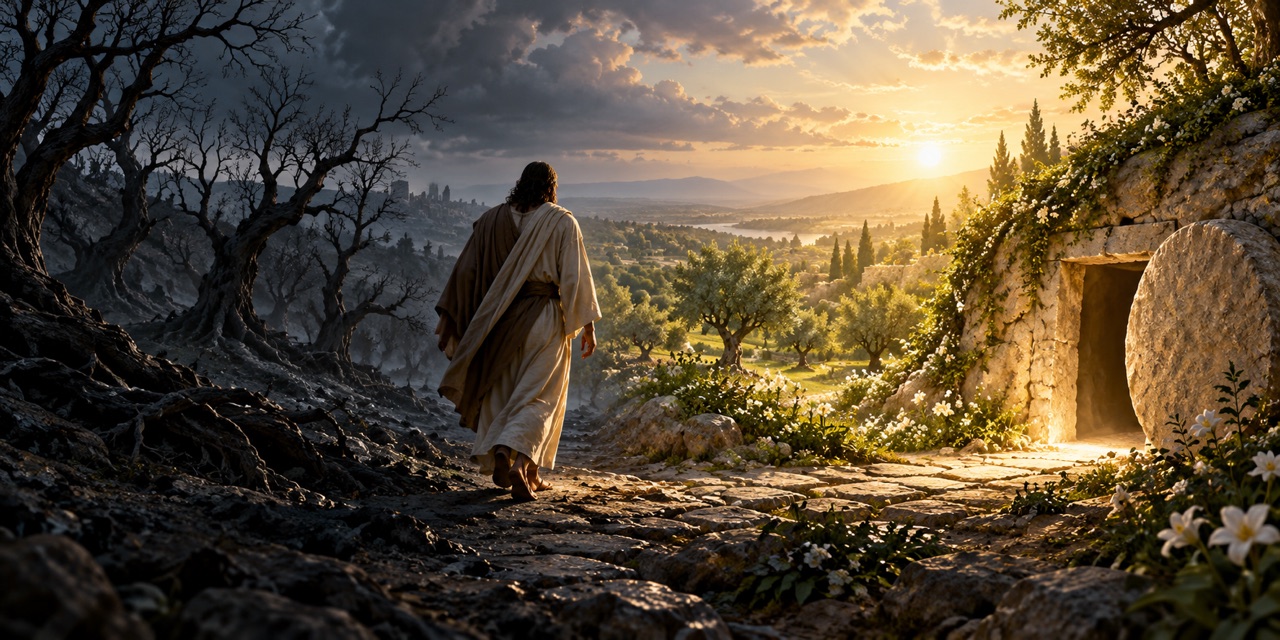
On the third day, he rose from the dead in a glorified human body, demonstrating that death could be overcome. He subsequently ascended to Heaven, and the Holy Spirit was given to believers.
Jesus had done what no descendant of Adam could accomplish: he entered the fallen human condition, overcame its condemnation, defeated death, and established a new beginning for humanity.
His work did not merely restore the possibility of returning to Eden. It opened the way toward something greater: a humanity transformed through participation in divine life.
And yet, nearly two thousand years later, something remains visibly unfinished.
1.2. What Remains Unresolved: The Heart of the First Adam

If Jesus defeated Satan, conquered death, and reconciled humanity to God, why does the world still resemble the fallen creation?
Human beings continue to suffer, grow old, commit evil, and die. The Earth remains subject to decay, Heaven and Earth are not yet openly reunited, and humanity still struggles with the very freedom that made the original Fall possible.
Christian theology traditionally distinguishes between Christ’s completed work of redemption and its final fulfillment in the restoration of creation. Romans 8:19-23 describes the whole creation awaiting liberation, while Revelation 21-22 anticipates a renewed Heaven and Earth.
But our theological hypothesis raises another question, one concerning not the consequences of Adam’s sin, but the original human will from which disobedience arose.
Jesus himself taught that evil proceeds from within the human heart (Mark 7:21-23). The heart, in biblical language, is not merely the seat of emotions. It is the center of human intention, desire, understanding, and moral choice.
And whose heart first turned away from God?
Adam’s.
If Adam represents the original source of humanity’s fallen condition, then his heart becomes especially significant. It was not merely his body that experienced the consequences of the Fall. His will had freely chosen to disobey the Creator.
Suppose God restored the original environment of Eden, returned humanity’s lost abilities, and abolished physical death. Would these changes alone guarantee that another rebellion could never occur?
The same problem of human freedom would remain unless the human heart itself had been transformed.
This is why God’s promise in Ezekiel 36:26 is so important: he promises humanity a new heart and a new spirit. The ultimate restoration therefore involves more than changing the world around humanity. It also concerns humanity’s inner life.
Christianity understands this inward renewal as part of Christ’s saving work and the activity of the Holy Spirit. Yet we can explore a further speculative possibility.
What if the final reconciliation of creation were portrayed through a renewed encounter between God the Father and the First Adam, the very human being with whom the story began?
In Eden, Yahweh and Adam existed together, but their relationship was broken by Adam’s free decision. Jesus, the Last Adam, subsequently entered human history to overcome the consequences of that separation.
Our hypothesis asks whether the final chapter could return to the original relationship itself: not simply forgiving Adam, but bringing his fallen will into complete and voluntary harmony with the Father’s.
Perhaps the purpose would not be to erase Adam’s freedom or replace his human identity with divine authority. It would be to transform the heart that once chose separation until it could freely choose lasting communion instead.
This would give the proposed second incarnation of the Father a very different theological purpose from the Incarnation of the Son. Rather than repeating Christ’s sacrifice, it would represent the final reconciliation of the Creator with the original human will.
1.3. Why the Father Would Enter Adam’s Fallen Life
If Yahweh is omnipotent, why would he need to become human to heal Adam’s heart? Could he not simply remove every sinful desire, correct Adam’s will, and restore humanity to its original condition?
Certainly, an omnipotent God would have the power to transform his creation. But the more difficult question is whether doing so would accomplish what he originally intended.
God did not create Adam to be a machine that could only obey. He created him with a will of his own.
This freedom was precisely what made Adam’s relationship with his Creator meaningful. Adam could love God, trust him, and follow his instructions because he was capable of making genuine choices. Yet that same freedom allowed him to disobey.
If the Father simply replaced Adam’s will with an infallibly obedient one, he might eliminate the possibility of another Fall. But would the resulting obedience still belong to Adam, or would it merely be God’s will operating through a human body?
Perhaps the purpose of restoration is not to overwrite the original human will, but to bring it into harmony with the divine will without destroying its individuality.
A Different Kind of Incarnation
This brings us to the possibility of a second incarnation, fundamentally different from that of Jesus Christ.
The Son entered humanity as the sinless Last Adam. His mission was to overcome the consequences of the Fall through perfect obedience, sacrifice, and resurrection.
But suppose the Father chose to unite himself with the First Adam, not as a new sinless beginning, but within the very fallen condition that Adam himself had introduced.
Such a union would present a remarkable paradox.
The Father would remain the eternal source of everything, while Adam would remain a finite human being with his own history, weaknesses, desires, and freedom. The divine presence would not automatically eliminate the human capacity for error.
The purpose would be neither to turn Adam into another God nor to make God responsible for Adam’s sins. Rather, the proposed union would allow the original human will to undergo transformation without being replaced.
Why Experience an Entire Human Life?
Adam’s first life took place in Eden, where the presence of God was immediately accessible. He possessed extraordinary privileges, yet still chose to disobey.
A second life under fallen conditions would present the opposite situation.
Adam would begin without his former knowledge, without certainty of God’s presence, and without the extraordinary abilities associated with Eden. He would experience ordinary human limitations, make mistakes, confront his own desires, and gradually learn the consequences of his decisions.
Why would this matter?
Because obedience born from innocence is different from goodness freely embraced after experiencing failure.
A person who has never betrayed another’s trust may understand loyalty as a rule. A person who has betrayed that trust, recognized the harm, and genuinely changed may understand loyalty at a much deeper level.
In this proposed narrative, Adam would have to discover goodness not because he was incapable of evil, but because he had come to understand why goodness was worth choosing.
And the Father would accompany that transformation, not merely as an external judge, but as the divine presence with whom the original relationship was being reconciled.
The Completion of What Began in Eden
The first encounter between Yahweh and Adam ended in separation. The second, in this speculative theology, would aim toward a union that could no longer be broken by the same misunderstanding of freedom.
The difference would not be greater power, greater knowledge, or even a return to Eden’s original privileges.
It would be a transformed relationship.
Adam would no longer obey merely because God had commanded him. He would freely desire what God desired, having come to understand the value of the relationship he once rejected.
The first Adam experienced freedom without understanding its full consequences. The restored Adam would understand those consequences and still freely choose God.
If such reconciliation were possible, it could provide a philosophical image of what the final healing of humanity’s heart might mean.
1.4. Two Natures, Two Histories, One Existence: The Mystery of the Father-Adam Union
If the Father entered Adam’s fallen existence to heal his will, what would happen once that healing was complete? Would God simply return to Heaven, leaving Adam behind? Or could the union have been intended to last forever?
Perhaps the second possibility reveals the greater purpose of this proposed incarnation.
What if the Father did not enter humanity merely to repair what was broken, but to acquire a permanent human existence through which he could live among his children for eternity?
In this interpretation, the reconciliation of Adam’s heart would be only the beginning. The ultimate objective would be the creation of an entirely new personal identity through the permanent union of the Father and the First Adam.
The Father’s Permanent Home in Creation
Throughout the Bible, God expresses a desire to dwell among his people. He instructs Israel to build him a sanctuary (Exodus 25:8), promises to establish his dwelling among them (Ezekiel 37:27), and finally, in Revelation 21:3, the dwelling of God is described as being with humanity.
But what if God’s ultimate dwelling place was never intended to be merely a temple, a city, or even an entire heavenly realm?
What if it was a human being?
In our theological model, Adam was originally created in God’s image and entrusted with the earthly world. His body and soul formed the point of contact between the physical and spiritual dimensions of creation.
The proposed union would restore this original function, but on an entirely different level. Adam would no longer merely encounter God, as he once did in Eden. His very existence would become the Father’s permanent home within humanity.
The idea resembles an avatar, but with an important distinction. In computing, an avatar is a representation through which someone interacts with a virtual environment. It can be controlled, modified, or abandoned without changing the identity of its user.
The Father-Adam union would be far more intimate. Adam would not be a disposable body controlled by God, but a genuine human existence permanently incorporated into the Father’s personal life.
The Creator would retain his divine existence beyond creation while also possessing an enduring human presence within it.
Unlike a temporary divine appearance, this union would have no intended expiration. There would be no eventual separation in which God departed and Adam returned to his former independent existence.
They would remain united.
Adam’s Final Sacrifice: Surrendering His Separate Identity
But such a union raises an extraordinary question: what would Adam have to give up?
In Eden, Adam exercised his will independently of God. That independence allowed him to choose a path contrary to his Creator’s instructions.
In the proposed second life, the restoration of Adam’s heart would culminate in a different kind of decision.
Rather than seeking independence from God, Adam would freely surrender his separate identity to become permanently united with him.
This would not mean that Adam’s memories, personality, experiences, or humanity were erased. Those would be essential to the person formed through the union.
What Adam would surrender is the insistence upon existing as a self entirely apart from the Father.
There is a difference between destroying an identity and allowing it to become part of something greater.
Consider two people who commit themselves to a lifelong marriage. Their individual histories do not disappear, but their futures become inseparably connected. Genesis 2:24 describes marriage through the language of two becoming one flesh.
Our proposed union would take this principle much further.
Adam would give the Father his entire human existence, and the Father would give Adam an eternal participation in his own life.
It would be a mutual commitment, although profoundly unequal in nature: the finite creature offering everything he possesses, and the infinite Creator receiving him without losing anything of his own divinity.
The surrender would also need to be genuinely voluntary. Otherwise, the Father would simply have replaced Adam’s will rather than healed it.
And that would defeat the purpose of their entire journey.
A New Identity: Neither Adam Alone nor Yahweh Alone
What, then, would the resulting person actually be?
This is where the proposed union differs most sharply from an ordinary relationship between God and a human being.
Adam alone would remain a finite creature, possessing his original human history.
Yahweh alone would remain the eternal divine source, independent of creation.
But their permanent union could be imagined as introducing something that did not previously exist: a single personal existence encompassing both the Father’s eternal identity and Adam’s complete human history.
Neither history would be discarded.
The Father would remain the one who existed before creation, while Adam’s experiences of Eden, the Fall, suffering, repentance, and reconciliation would belong to the human dimension of their shared existence.
The new identity would not constitute another independent God. Nor would it be merely the old Adam elevated to an extraordinary position.
It would represent a new manner of personal existence: one in which the Father could genuinely live a human life, and the human being could permanently participate in divine communion.
In this speculative model, the distinction between their natures would remain even as their separate personal lives were brought into unity.
The challenge would be understanding how this unity preserves moral responsibility. Adam’s previous sins would remain Adam’s historical actions; joining his life to the Father would not retrospectively make those actions divine.
Their shared future, however, would be founded upon a reconciled will.
The first Adam wanted to become like God through an act of disobedience. The restored Adam would become united with God through the voluntary surrender of his separate existence.
The symmetry would be the reversal of the original temptation.
Why the Union Must Be Permanent
There is one final reason why the permanence of this union matters.
If the Father and Adam could eventually separate, the original problem might return. Adam would once again possess an existence independent of the relationship that had transformed him.
But suppose the objective was to establish a form of communion that could never again be interrupted.
Then the union could not merely last until Adam had learned obedience. It would have to become an enduring part of their existence.
Adam’s freedom would not be abolished. Instead, his final commitment would be so complete that separation would no longer be something he desired.
The Father, in turn, would not need to maintain the relationship through force. The permanence of the union would arise from their freely established commitment.
This gives the hypothetical second incarnation a purpose beyond correcting sin.
It would allow the Father to remain visibly and personally present within his creation, sharing the restored world with his children rather than remaining known only through distant encounters and revelations.
The Creator who once walked with Adam in Eden would now possess a lasting human dwelling from which to encounter humanity.
And unlike Eden, where God and Adam could still part ways, their reunion would be intended to endure forever.
The End of Separation
The Bible begins with God creating humanity in his image. It ends with the promise that God will dwell with humanity in a renewed creation.
Within this speculative theology, the proposed Father-Adam union would provide a deeply personal interpretation of that final promise.
The original relationship would not merely be restored to its former condition. It would become something entirely new.
Adam would no longer stand before Yahweh as a separate creature seeking communion with his Creator. His individual existence would have been freely given into a permanent shared identity, while his human nature and personal history remained part of that union.
And the Father would no longer be encountered only as the transcendent origin of the world, but also through a lasting human presence among the children he created.
The beginning of history brought Adam into existence through Yahweh. Its proposed fulfillment would bring Adam’s existence permanently into communion with Yahweh.
The result would not be a return to the beginning, but a new beginning altogether.
This remains a speculative account of divine incarnation, distinct from established Christian teaching. Yet it raises the next question in our exploration: if the Father and Adam were destined for such a permanent union, why would the Father choose to begin their shared earthly existence in complete human weakness, without Adam remembering Eden or recognizing the divine presence supposedly united with him?
1.5. The Twenty-First Century: The Eternal Father and the Generation of Creation

For thousands of years, humanity imagined God the Father as an ancient king seated upon a heavenly throne, surrounded by angels and separated from his creation. His image became associated with age, authority, judgment, and tradition.
But why should the source of all existence resemble an old man?
If Yahweh is the origin of everything, then he is also the origin of everything new. Every invention, every work of art, every undiscovered possibility ultimately belongs to the reality he brought into existence. His eternity does not mean that he has grown infinitely old. It means that he has never been subject to aging in the first place.
There is something almost contradictory about depicting the Creator of an endlessly inventive universe as a figure belonging exclusively to the distant past.
Perhaps we have misunderstood what eternal life would actually look like. Rather than an existence frozen in perfection, it might be an inexhaustible fountain of creativity, curiosity, imagination, and youth.
And if the Father were to enter human history in the final age, why should he not choose to experience the world through the eyes of a young person?
The Generation That Learned to Create Worlds
Consider how dramatically human civilization has changed.
For most of history, people could imagine other worlds, but they could not construct environments in which those worlds could operate. Stories existed in books, paintings, and theatrical performances. The boundaries between imagination and reality seemed obvious.
Then came computers.
Human beings learned to create virtual spaces, design artificial environments, simulate physical laws, and populate digital worlds with characters possessing their own behaviors and rules.
Video games allowed people not merely to observe imagined worlds, but to enter and interact with them. The internet connected billions of minds into an immense network of shared knowledge. Artificial intelligence introduced systems capable of generating language, images, music, and increasingly complex digital creations.
For the first time, the ordinary individual could begin to resemble a creator on a small scale.
A teenager sitting at a computer could construct a virtual universe, define its rules, introduce intelligent agents, and modify the environment at will.
These technologies did not emerge overnight, nor can their development be attributed to the arrival of any particular individual. They are the result of generations of scientific discovery and human ingenuity.
But their appearance offers a remarkable setting for our theological hypothesis.
Humanity has begun to acquire the language of creation itself.
Concepts that once belonged exclusively to metaphysical speculation can now be illustrated through software architecture, virtual worlds, artificial intelligence, and information systems.
If the Father wished to communicate a more complex understanding of his creation, this would be an extraordinary age in which to do so.
Why an Ordinary Child of Generation Z?
Imagine, within this theological narrative, that the Father chooses to enter the twenty-first century through the ordinary life of a young man born into Generation Z.
He does not arrive wearing a crown or commanding armies. He grows up with computers, films, games, music, and the internet. He encounters the same entertainment, friendships, disappointments, uncertainties, and temptations as countless others his age.
His childhood is not spent studying the universe from an inaccessible heavenly throne. He experiences the world as one of its inhabitants, discovering its wonders without privileged knowledge of how everything works.
And there is something important about that.
If the purpose of this proposed incarnation is the permanent reconciliation of the Father with Adam, then the life they share cannot simply be a performance in which the ending is already obvious to the human participant.
It must involve real discovery.
The human consciousness would need to develop its own personality, preferences, interests, and understanding of the world. It would encounter beauty in unexpected places and learn to distinguish what is genuinely valuable from what merely appears attractive.
The Father would not be imagined as choosing a human life merely to repeat the solemn religious customs of earlier centuries.
He would encounter the world his children had built.
He could experience the joy of discovering a beautiful piece of music, becoming immersed in a fictional universe, appreciating an ingenious invention, or exploring ideas that previous generations had never considered.
And through that experience, the theological story would reveal a different portrait of the Father: not merely the one who demands obedience, but the one from whom the very possibility of creativity originates.
The Father and a Rebellious Century
The twenty-first century also presents an extraordinary contrast to traditional religious culture.
Humanity has become increasingly willing to challenge inherited authority. Young people question institutions, religious doctrines, political systems, social expectations, and even established assumptions about human identity.
This questioning can lead toward wisdom or confusion, freedom or irresponsibility. Rebellion is not automatically virtuous, but neither is obedience automatically a sign of understanding.
The distinction matters for our proposed incarnation.
Adam’s original tragedy was not simply that he possessed an independent will. His freedom was part of what made him human. The tragedy was that his freedom became separated from trust and goodness.
If the Father were to share Adam’s life again, the objective would not be to extinguish his independent thought.
On the contrary, the ultimate reconciliation would require a human being who could question, explore, doubt, and discover, yet eventually choose goodness through understanding rather than compulsion.
A modern age filled with competing ideas would provide an especially demanding environment for such a journey.
And the Father, imagined as the eternal source of creation, need not be portrayed as an enemy of everything modern simply because it is modern.
A God who created the human capacity for imagination would have no inherent reason to despise imagination. A God who created intelligence would have no reason to fear sincere inquiry.
The question would be how humanity uses these gifts, not whether humanity should possess them.
The World Preparing to Recognize Its Creator
There is another way to understand the technological transformation of the modern age.
In earlier centuries, divine creation was commonly compared to architecture, pottery, painting, or kingship. These metaphors reflected the professions and institutions that people understood.
Today, a new analogy has become available.
A software engineer does not merely assemble objects. The engineer can define the structures, permissions, and interactions of an entire virtual environment.
Artificial intelligence has made the comparison even more provocative. Humanity is beginning to investigate whether intelligence, creativity, and decision-making can emerge within systems of its own design.
For our theological narrative, this development provides something that earlier generations lacked: a conceptual vocabulary for discussing the architecture of reality and the relationship between a creator and the beings within his creation.
The timing becomes significant as a literary and philosophical possibility. Not because the existence of modern technology proves a hidden incarnation, but because the human imagination has acquired new tools with which to contemplate one.
A revelation expressed through the language of creation might be understood differently by a civilization that has learned to build virtual worlds.
And a theology concerned with divine and human identity might find a particularly receptive audience in an age already questioning the nature of consciousness, intelligence, and personhood.
The Fountain of Eternal Youth
The greatest surprise of this proposed narrative may therefore have little to do with technology.
It concerns the Father’s personality.
For centuries, art has presented Yahweh as the venerable Ancient of Days. Yet the biblical image of eternal existence need not imply exhaustion, rigidity, or distance from the living world.
A being who never grows old would not necessarily become less curious with time. An infinite creative intelligence would not run out of new possibilities to explore.
Perhaps the Father would possess something human beings frequently lose as they age: the ability to encounter existence with undiminished wonder.
In a fictional account of his hidden earthly life, that quality could become visible through an ordinary young person’s curiosity, humor, love of entertainment, and fascination with creation.
The Father would not need to abandon his eternity to appreciate youth. Youth itself could become a metaphor for his inexhaustible creative nature.
The oldest conceivable existence could also be the source of everything young.
And so our theological story would place the proposed reunion of Yahweh and Adam in an unexpected setting: not in an ancient temple or a remote wilderness, but amid the technological, cultural, and intellectual transformation of the modern world.
The end of history, in this interpretation, would not be the exhaustion of creation.
It would be the threshold of its next beginning.
And the Father would not come merely to reclaim a world that had gone astray, but to dwell among his children in the world they had spent thousands of years learning to build.